
Selank (10 mg Vial) Dosage Protocol
Quickstart Highlights
Selank is a synthetic heptapeptide analog of tuftsin with demonstrated anxiolytic and anti-asthenic (energy-boosting) properties in human clinical trials[1][2]. In Russian studies, intranasal Selank produced anxiolytic effects comparable to benzodiazepines without sedation or dependence potential[1]. This educational protocol presents a once‑daily subcutaneous approach using practical dilution for accurate insulin‑syringe measurements.
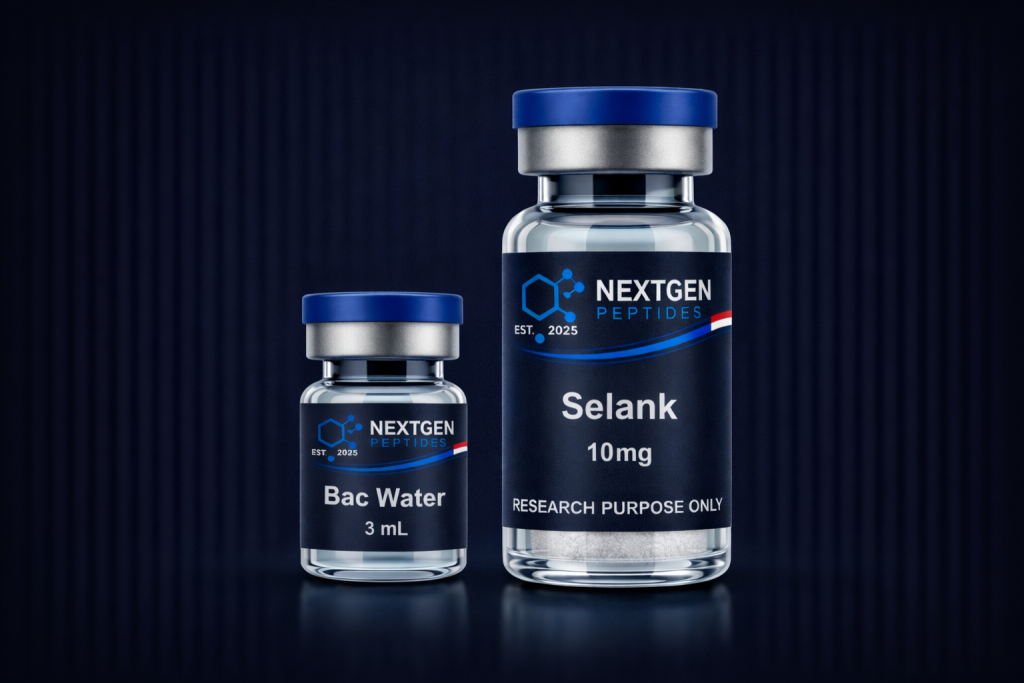
- Reconstitute: Add 3.0 mL bacteriostatic water (max vial capacity) → ~3.33 mg/mL concentration.
- Typical daily range: 300–500 mcg once daily subcutaneously (gradual titration).
- Easy measuring: At 3.33 mg/mL, 1 unit = 0.01 mL ≈ 33.3 mcg on a U‑100 insulin syringe.
- Storage: Lyophilized: freeze at −20 °C (−4 °F); after reconstitution, refrigerate at 2–8 °C (35.6–46.4 °F); avoid freeze–thaw cycles.
Dosing & Reconstitution Guide
Educational guide for reconstitution and daily dosing
Standard / Gradual Approach (3 mL = ~3.33 mg/mL)
|
Week |
Daily Dose |
Units (per injection) (mL) |
|---|---|---|
|
Weeks 1–2 |
300 mcg (0.3 mg) |
9 units (0.09 mL) |
|
Weeks 3–4 |
500 mcg (0.5 mg) |
15 units (0.15 mL) |
Frequency: Inject once daily subcutaneously[3]. A common cycling pattern is 4 weeks on, 4 weeks off to prevent tachyphylaxis, though continuous daily use has been studied in clinical trials for up to 14 days with good tolerability[2]. Some practitioners recommend administering 5 days per week with 2-day breaks[3].
For ≤10‑unit (≤0.10 mL) administrations, consider 30‑ or 50‑unit insulin syringes for improved readability.
Reconstitution Steps
- Draw 3.0 mL bacteriostatic water with a sterile syringe.
- Inject slowly down the vial wall; avoid foaming.
- Gently swirl/roll until dissolved (do not shake vigorously as peptides are delicate).
- Label and refrigerate at 2–8 °C (35.6–46.4 °F), protected from light.
Supplies Needed
Plan based on an 8–16 week protocol with 4-week cycles and gradual titration.
- Peptide Vials (Selank, 10 mg each):
- 8 weeks (one 4-week cycle) ≈ 2 vials
- 12 weeks (1.5 cycles) ≈ 4 vials
- 16 weeks (two complete cycles) ≈ 5 vials
- Insulin Syringes (U‑100):
- Per week: 7 syringes (1/day)
- 8 weeks: 56 syringes
- 12 weeks: 84 syringes
- 16 weeks: 112 syringes
- Bacteriostatic Water (10 mL bottles): Use ~3.0 mL per vial for reconstitution.
- 8 weeks (2 vials): 6 mL → 1 × 10 mL bottle
- 12 weeks (4 vials): 12 mL → 2 × 10 mL bottles
- 16 weeks (5 vials): 15 mL → 2 × 10 mL bottles
- Alcohol Swabs: One for the vial stopper + one for the injection site each day.
- Per week: 14 swabs (2/day)
- 8 weeks: 112 swabs → recommend 2 × 100‑count boxes
- 12 weeks: 168 swabs → recommend 2 × 100‑count boxes
- 16 weeks: 224 swabs → recommend 3 × 100‑count boxes
Protocol Overview
Concise summary of the once‑daily anxiolytic/nootropic regimen.
- Goal: Support reduction of anxiety and neurasthenia symptoms while providing anti-asthenic (energy-boosting) benefits[1][2].
- Schedule: Daily subcutaneous injections for 4-week cycles with 4-week breaks (8–16 weeks total protocol).
- Dose Range: 300–500 mcg daily with gradual titration.
- Reconstitution: 3.0 mL per 10 mg vial (~3.33 mg/mL) for accurate unit measurements.
- Storage: Lyophilized frozen; reconstituted refrigerated; avoid repeated freeze–thaw.
Dosing Protocol
Suggested daily titration approach.
- Start: 300 mcg daily for weeks 1–2; clinicians treating cognitive or anxiety issues often begin at this level[3].
- Target: 500 mcg daily by weeks 3–4 if lower doses are well-tolerated.
- Frequency: Once per day (subcutaneous); some protocols use 5 days per week with 2-day breaks[3].
- Cycle Pattern: 4 weeks on, 4 weeks off to prevent tachyphylaxis; repeat as needed.
- Timing: Any consistent time; rotate injection sites to prevent irritation.
Storage Instructions
Proper storage preserves peptide quality.
- Lyophilized: Store at −20 °C (−4 °F) for long-term stability (several months); refrigeration at 2–8 °C (35.6–46.4 °F) acceptable for shorter periods[10].
- Reconstituted: Refrigerate at 2–8 °C (35.6–46.4 °F); stable for approximately 1 month with minimal potency loss[10]. Prepare aliquots if needed and avoid freeze–thaw cycles.
- Allow vials to reach room temperature before opening to reduce condensation and moisture uptake.
Important Notes
Practical considerations for consistency and safety.
- Use new sterile insulin syringes for each injection; dispose in a sharps container immediately after use[9].
- Rotate injection sites (abdomen, thighs, upper arms) systematically to reduce local irritation and prevent tissue changes[7].
- Inject slowly and steadily; wait a few seconds before withdrawing the needle.
- Document daily dose, timing, and site rotation to maintain consistency throughout the protocol.
- Multi-use bacteriostatic water vials should be dated upon opening and discarded within 28 days[9].
How This Works
Selank is a synthetic analog of the immunomodulatory peptide tuftsin, consisting of the sequence Thr-Lys-Pro-Arg-Pro-Gly-Pro. In Russian clinical trials for anxiety disorders and neurasthenia, intranasal Selank produced anxiolytic effects comparable to benzodiazepines while also providing anti-asthenic (energy-boosting) benefits without sedative side effects or dependence potential[1][2]. Preclinical studies in primates demonstrated that intranasal Selank eliminated fear and anxiety behaviors with long-term stabilizing effects on neurobehavior[4]. Rodent studies confirmed robust anxiolytic efficacy comparable to classical tranquilizers[5]. While most published human data utilized intranasal dosing (the original formulation), subcutaneous administration has shown effectiveness in research settings with consistent absorption and ease of dose measurement[3]. A 14-day continuous course was well-tolerated and effective in human trials[2], and even high-dose applications have been explored for conditions such as attenuating opioid withdrawal symptoms in animal models[5].
Potential Benefits & Side Effects
Observations from clinical and preclinical literature.
- Produces anxiolytic effects comparable to benzodiazepines in human clinical trials without sedation or dependence risk[1].
- Provides anti-asthenic (energy-boosting) benefits alongside anxiety reduction[2].
- Induces lasting neurobehavioral changes; primate studies showed elimination of fear/anxiety behaviors with long-term stabilizing effects[4].
- Generally well tolerated in clinical studies; a 14-day continuous course was well-tolerated and effective in human trials[2].
- Occasional mild injection-site reactions (redness, minor irritation) may occur with subcutaneous administration; proper site rotation minimizes this risk.
- Lacks sedative side effects typical of classical anxiolytics, allowing for daytime use without impairment[1].
- Has been explored at higher doses for experimental applications such as attenuating opioid withdrawal symptoms, indicating a wide therapeutic range[5].
Lifestyle Factors
Complementary strategies for optimal cognitive and anxiolytic outcomes.
- Maintain consistent sleep hygiene and aim for 7–9 hours of quality sleep to support neurological function and stress resilience.
- Incorporate regular physical activity; both aerobic exercise and resistance training support mood regulation and cognitive performance.
- Practice stress-management techniques such as mindfulness, meditation, or breathwork to complement Selank’s anxiolytic effects.
- Support nutritional status with adequate protein, omega-3 fatty acids, and micronutrients essential for neurotransmitter synthesis.
- Minimize alcohol and stimulant use, which can interfere with anxiety management and neurological stability.
Injection Technique
General subcutaneous guidance from clinical best-practice resources[7][8].
- Wash hands thoroughly and prepare a clean work surface.
- Clean the vial stopper with an alcohol swab; allow to dry completely.
- Draw the appropriate volume into a sterile insulin syringe; remove air bubbles by flicking the syringe and expelling air.
- Clean the injection site with a fresh alcohol swab; allow skin to dry to prevent stinging.
- Pinch a skinfold of subcutaneous tissue; insert the needle at 90° into the subcutaneous layer[7].
- Do not aspirate for subcutaneous injections; inject slowly and steadily[8].
- Withdraw the needle straight out after injection; apply gentle pressure if minor bleeding occurs.
- Dispose of the used syringe immediately in an appropriate sharps container; never reuse needles or syringes[9].
- Rotate sites systematically (abdomen at least 2 inches from navel, front/outer thighs, upper arms) to avoid lipohypertrophy[7].
Recommended Source
We recommend Pure Lab Peptides for high‑purity Selank (10 mg).
Why Pure Lab Peptides?
- High‑purity, third‑party‑tested lots with batch Certificates of Analysis (COAs).
- Consistent, ISO‑aligned handling and comprehensive documentation.
- Reliable fulfillment with proper cold‑chain management to maintain peptide integrity.
- Transparent sourcing and quality control procedures for research-grade peptides.