
Melanotan II (10 mg Vial) Dosage Protocol
Quickstart Highlights
Melanotan II is a synthetic analog of α-melanocyte-stimulating hormone studied for its ability to increase skin pigmentation and noted for inducing erectile activity as a side effect[1]. Early human trials identified effective daily doses in the range of 1–2 mg for tanning, with conservative protocols starting lower to minimize side effects such as nausea and flushing[2][3]. This educational protocol presents a once-daily subcutaneous titration approach using practical dilution for clear insulin-syringe measurements.
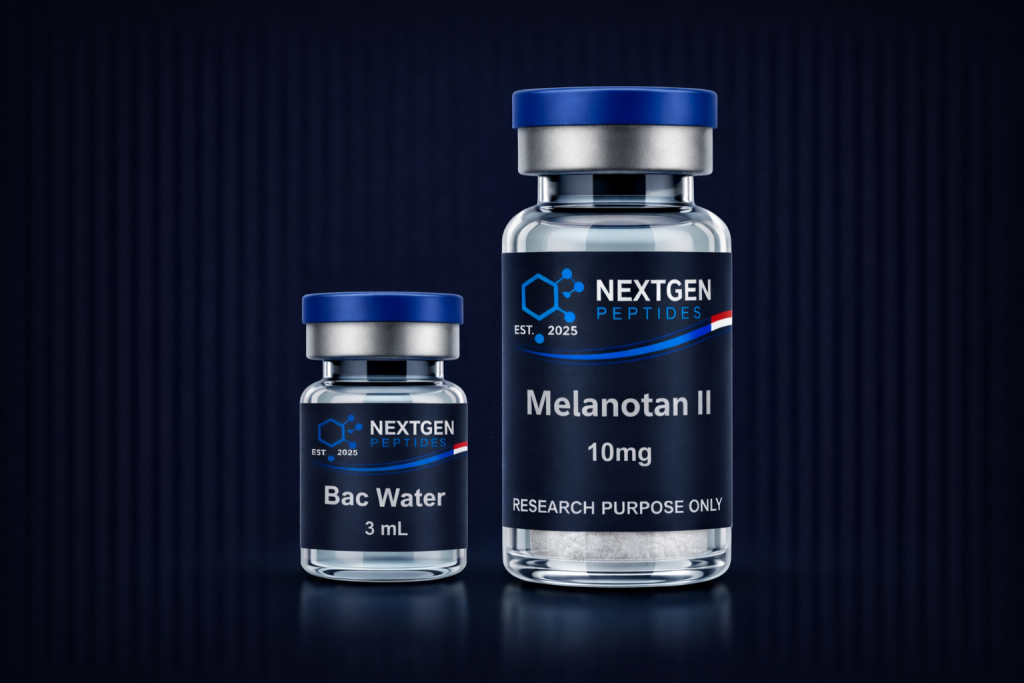
- Reconstitute: Add 3.0 mL bacteriostatic water → 3.33 mg/mL concentration.
- Typical daily range: 250–1000 mcg once daily (gradual titration over 8–12 weeks).
- Easy measuring: At 3.33 mg/mL, 1 unit = 0.01 mL ≈ 33.3 mcg on a U-100 insulin syringe.
- Storage: Lyophilized: freeze at −20 °C (−4 °F) or below; after reconstitution, refrigerate at 2–8 °C (35.6–46.4 °F); use within 1–2 weeks.
Dosing & Reconstitution Guide
Educational guide for reconstitution and daily dosing
Standard / Gradual Titration (3 mL = 3.33 mg/mL)
|
Week |
Daily Dose |
Units (per injection) (mL) |
|---|---|---|
|
Weeks 1 |
250 mcg (0.25 mg) |
7.5 units (0.075 mL) |
|
Weeks 2 |
500 mcg (0.5 mg) |
15 units (0.15 mL) |
|
Weeks 3 |
750 mcg (0.75 mg) |
22.5 units (0.225 mL) |
|
Week4-8 |
1000 mcg (1 mg) |
30 units (0.30 mL) |
|
Maintenance |
500–1000 mcg |
15–30 units |
Frequency: Inject once daily subcutaneously during the initial 8-week tanning phase; transition to 1–2 injections per week for maintenance dosing to sustain pigmentation[3]. This schedule uses the standard 3.0 mL dilution for consistent unit measurements. For ≤10-unit (≤0.10 mL) administrations, consider 30- or 50-unit insulin syringes for improved readability.
Reconstitution Steps
- Draw 3.0 mL bacteriostatic water with a sterile syringe.
- Inject slowly down the vial wall to avoid foaming; do not shake vigorously.
- Gently roll or swirl the vial until the powder is fully dissolved.
- Label the vial with the reconstitution date and store refrigerated at 2–8 °C (35.6–46.4 °F), protected from light.
Advanced / Aggressive Approach (3.0 mL = ~16.67 mg/mL)
|
Week |
Daily Dose |
Units (per injection) (mL) |
|---|---|---|
|
Weeks 1–2 |
5 mg (5000 mcg) |
30 units (0.30 mL) |
|
Weeks 3–4 |
10 mg (10,000 mcg) |
60 units (0.60 mL) |
|
Weeks 5–8 |
15 mg (15,000 mcg) |
90 units (0.90 mL) |
Note: Advanced dosing (15–20 mg/day) is based on short‑term clinical trial protocols[4][5] for severe mitochondrial conditions and should only be pursued under medical supervision. At this concentration, doses up to 15 mg fit in a single syringe (90 units); 20 mg doses should be split into two separate subcutaneous injections at different sites. Clinical trials have not extensively evaluated SS‑31 beyond 12 weeks; extended use requires careful monitoring.
Supplies Needed
Plan based on an 8–16 week daily protocol with gradual titration (including transition to maintenance dosing).
- Peptide Vials (Melanotan II, 10 mg each):
- 8 weeks ≈ 5 vials (~45–50 mg total)
- 12 weeks ≈ 8 vials (~70–75 mg total)
- 16 weeks ≈ 10 vials (~95–100 mg total)
- Insulin Syringes (U-100, 1 mL):
- Per week (daily dosing): 7 syringes
- 8 weeks: 56 syringes
- 12 weeks: 84 syringes
- 16 weeks: 112 syringes
- Bacteriostatic Water (10 mL bottles): Use 3.0 mL per vial for reconstitution.
- 8 weeks (5 vials): 15 mL → 2 × 10 mL bottles
- 12 weeks (8 vials): 24 mL → 3 × 10 mL bottles
- 16 weeks (10 vials): 30 mL → 3 × 10 mL bottles
- Alcohol Swabs: One for the vial stopper + one for the injection site each day.
- Per week: 14 swabs (2/day)
- 8 weeks: 112 swabs → recommend 2 × 100-count boxes
- 12 weeks: 168 swabs → recommend 2 × 100-count boxes
- 16 weeks: 224 swabs → recommend 3 × 100-count boxes
Protocol Overview
Concise summary of the once-daily subcutaneous regimen.
- Goal: Increase skin pigmentation (tanning) through melanocortin receptor activation[1].
- Schedule: Daily subcutaneous injections for 6–8 weeks during loading phase, then maintenance dosing 1–2× weekly[3].
- Dose Range: 250–1000 mcg daily with gradual titration to minimize side effects.
- Reconstitution: 3.0 mL per 10 mg vial (3.33 mg/mL) for accurate unit measurements.
- Storage: Lyophilized frozen at −20 °C (−4 °F); reconstituted refrigerated at 2–8 °C (35.6–46.4 °F); use within 1–2 weeks[7].
Dosing Protocol
Suggested daily titration approach based on clinical research.
- Start: 200–250 mcg daily; increase by 100–250 mcg increments every 1–2 weeks as tolerated[2].
- Target: 500–1000 mcg daily by Weeks 4–8 (studied effective range is 1–2 mg/day)[1].
- Frequency: Once per day (subcutaneous) during loading phase.
- Cycle Length: 6–8 weeks for initial tanning, then switch to maintenance dosing.
- Maintenance: 500–1000 mcg administered 1–2× per week to sustain pigmentation[3].
- Timing: Any consistent time; rotate injection sites to reduce irritation.
Storage Instructions
Proper storage preserves peptide stability and potency.
- Lyophilized: Store at −20 °C (−4 °F) or below in dry, dark conditions; keep desiccated to minimize moisture exposure[7].
- Reconstituted: Refrigerate at 2–8 °C (35.6–46.4 °F); use within 1–2 weeks with bacteriostatic water preservative[7].
- Avoid freeze–thaw: Do not refreeze reconstituted solution; prepare aliquots if longer storage needed.
- Allow vials to reach room temperature before opening to reduce condensation.
Important Notes
Practical considerations for consistency and safety.
- Use new sterile insulin syringes for each injection; dispose in a sharps container immediately[9].
- Rotate injection sites systematically (abdomen, thighs, upper arms) to reduce local irritation and scarring[10].
- Clean vial stopper and injection site with alcohol swabs before each use; allow to air dry[11].
- Inject slowly and steadily; wait a few seconds before withdrawing the needle.
- Document daily dose, injection site, and any side effects to maintain consistency and track tolerance.
- Safety warning: Do not exceed 2 mg per day; case reports document serious systemic toxicity and rhabdomyolysis at mega-doses (6 mg)[4].
How This Works
Melanotan II is a synthetic cyclic heptapeptide analog of α-melanocyte-stimulating hormone that binds to melanocortin receptors, particularly MC1R and MC4R[1]. Activation of MC1R on melanocytes stimulates melanin production and distribution, resulting in increased skin pigmentation even without UV exposure[2]. Early Phase I studies in humans identified 0.025 mg/kg per day (approximately 1.5–2 mg for an average adult) as an appropriate dose, with measurable tanning observed after just five low doses administered over two weeks[1]. The peptide’s subcutaneous administration allows for steady melanocortin receptor activation, with effects accumulating over the course of daily injections during the initial tanning phase[3].
Potential Benefits & Side Effects
Observations from clinical trials and case reports.
Potential Benefits
- Increases skin pigmentation (tanning) without UV exposure requirement[1][2].
- Tanning effects observable after 5–10 daily injections in most individuals[1].
- May induce spontaneous erections in men as a noted side effect (MC4R activation)[3][5].
- Maintenance dosing (1–2× weekly) can sustain pigmentation after initial loading phase[3].
Common Side Effects
- Nausea (dose-dependent; most common at higher doses)[1][2].
- Facial flushing and increased skin warmth[3].
- Reduced appetite and mild fatigue[1].
- Spontaneous erections or increased libido in men[5].
- Injection site reactions (redness, mild stinging)[9].
Serious Risks & Warnings
- Not FDA-approved: Melanotan II is not an approved medication; use carries regulatory and safety risks[6].
- Dose-limiting toxicity: Severe sympathomimetic symptoms and rhabdomyolysis reported at 6 mg dose[4].
- Mole changes: May alter pigmentation of existing moles; theoretical melanoma concerns warrant caution[6].
- Cardiovascular effects: Transient increases in heart rate and blood pressure possible at higher doses[3].
Lifestyle Factors
Complementary strategies for safe and effective outcomes.
- UV exposure: Melanotan II increases melanin without UV, but some users combine with minimal UV exposure; always use appropriate sun protection to reduce skin cancer risk[6].
- Hydration: Maintain adequate fluid intake, especially if experiencing nausea or appetite suppression.
- Monitoring: Inspect moles and skin regularly for changes; seek dermatological evaluation if new or changing lesions appear[6].
- Dose discipline: Adhere strictly to conservative dosing protocols; never exceed 2 mg per day to avoid serious adverse effects[4].
Injection Technique
Subcutaneous injection guidance from clinical best-practice resources[9][11].
- Clean the vial stopper and injection site with alcohol swabs; allow both to air dry completely[11].
- Use a 1 mL insulin syringe (29–31 gauge, ½ inch needle) for subcutaneous administration[9].
- Pinch a fold of skin approximately 1 inch thick at the injection site (abdomen preferred, at least 2 inches from navel)[10].
- Insert the needle at 45–90° depending on body composition; release the pinch after needle insertion[10].
- Do not aspirate for subcutaneous injections; inject slowly and steadily[11].
- Withdraw the needle at the same angle; apply gentle pressure with clean gauze if needed.
- Rotate sites systematically to avoid lipohypertrophy or scarring[10].
- Dispose of used syringes immediately in a proper sharps container; never reuse needles[9].
Recommended Source
We recommend Pure Lab Peptides for high-purity Melanotan II (10 mg).
Why Pure Lab Peptides?
- High-purity, third-party-tested lots with batch certificates of analysis (COAs).
- Consistent, ISO-aligned handling and quality documentation.
- Reliable fulfillment with proper cold-chain shipping to maintain peptide integrity.