
MOTS-C (5 mg Vial) Dosage Protocol
Quickstart Highlights
MOTS-C is a 16‑amino-acid mitochondrial‑derived peptide encoded in the mtDNA 12S rRNA region[1][2]. Discovered in 2015, it enhances metabolic homeostasis through AMPK activation[1][3], increases sharply with exercise (~12‑fold in muscle)[3], and declines with age. This educational protocol presents a once‑daily subcutaneous approach aligned with preclinical findings and emerging clinical use.
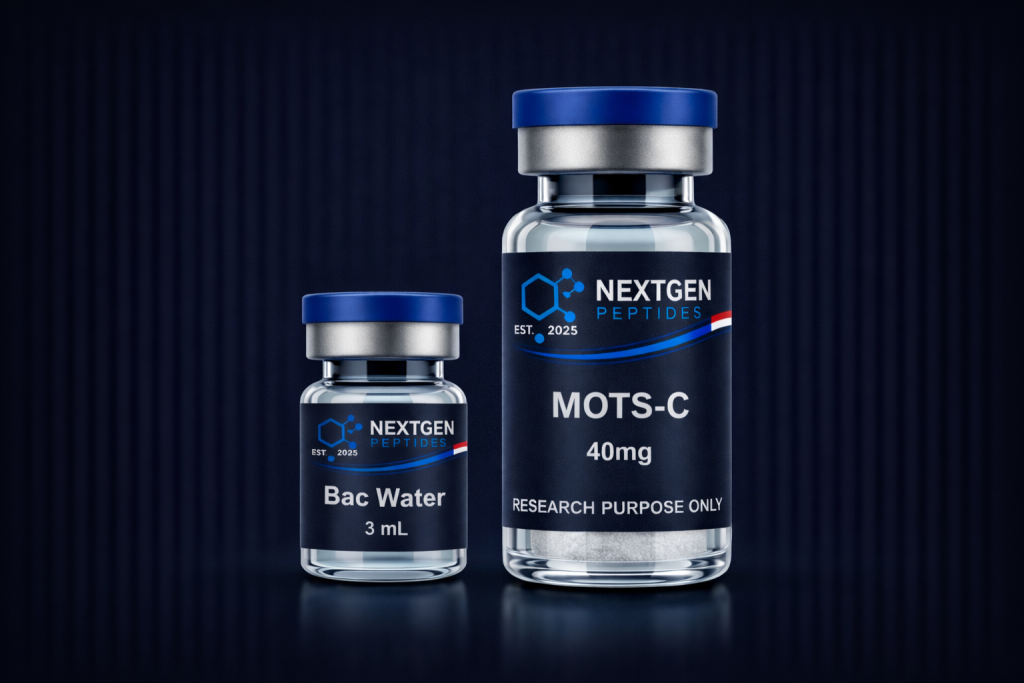
- Reconstitute: Add 3.0 mL bacteriostatic water → ~1.67 mg/mL concentration.
- Typical daily range: 500–1500 mcg once daily (gradual titration from 500 mcg).
- Easy measuring: At 1.67 mg/mL, 1 unit = 0.01 mL ≈ 16.7 mcg on a U‑100 insulin syringe.
- Storage: Lyophilized: freeze at −20 °C (−4 °F); after reconstitution, refrigerate at 2–8 °C (35.6–46.4 °F) and use within 2–4 weeks.
Dosing & Reconstitution Guide
Educational guide for reconstitution and daily dosing
Standard / Gradual Approach (3 mL = ~1.67 mg/mL)
|
Week |
Daily Dose |
Units (per injection) (mL) |
|---|---|---|
|
Weeks 1-2 |
500 mcg (0.5 mg) |
30 units (0.30 mL) |
|
Weeks 3-4 |
1000 mcg (1.0 mg) |
60 units (0.60 mL) |
|
Week 5-6 |
1500 mcg (1.5 mg)
|
90 units (0.90 mL) |
|
Weeks 7-8 |
2000 mcg (2.0 mg) |
120 units (two 60‑unit injections)* |
Frequency: Inject once daily subcutaneously (morning administration preferred). *For 2.0 mg doses (120 units total), split into two separate 60‑unit injections at different sites, or use a more concentrated 2.0 mL reconstitution (2.5 mg/mL → 80 units for 2 mg). Alternate protocol: Some users employ 2–3 injections per week at higher per‑dose amounts (e.g., 3–5 mg twice weekly); consult literature for guidance[6].
Reconstitution Steps
- Draw 3.0 mL bacteriostatic water with a sterile syringe.
- Inject slowly down the vial wall; avoid foaming.
- Gently swirl/roll until dissolved (do not shake vigorously).
- Label and refrigerate at 2–8 °C (35.6–46.4 °F), protected from light; use within 2–4 weeks[12].
Supplies Needed
Plan based on an 8–16 week daily protocol with gradual titration.
- Peptide Vials (MOTS-C, 5 mg each):
- 8 weeks ≈ 12 vials (average ~1.1 mg/day)
- 12 weeks ≈ 18 vials
- 16 weeks ≈ 24 vials
- Insulin Syringes (U‑100):
- Per week: 7 syringes (1/day)
- 8 weeks: 56 syringes
- 12 weeks: 84 syringes
- 16 weeks: 112 syringes
- Bacteriostatic Water (10 mL bottles): Use ~3.0 mL per vial for reconstitution.
- 8 weeks (12 vials): 36 mL → 4 × 10 mL bottles
- 12 weeks (18 vials): 54 mL → 6 × 10 mL bottles
- 16 weeks (24 vials): 72 mL → 8 × 10 mL bottles
- Alcohol Swabs: One for the vial stopper + one for the injection site each day.
- Per week: 14 swabs (2/day)
- 8 weeks: 112 swabs → recommend 2 × 100‑count boxes
- 12 weeks: 168 swabs → recommend 2 × 100‑count boxes
- 16 weeks: 224 swabs → recommend 3 × 100‑count boxes
Protocol Overview
Concise summary of the once‑daily regimen based on preclinical evidence.
- Goal: Support metabolic homeostasis, enhance insulin sensitivity, and promote healthy aging through AMPK activation[1][2].
- Schedule: Daily subcutaneous injections for 4–8 weeks, followed by an equal‑length break (cycling approach).
- Dose Range: 500–2000 mcg daily with gradual titration over weeks.
- Reconstitution: 3.0 mL per 5 mg vial (~1.67 mg/mL) for accurate unit measurements.
- Storage: Lyophilized frozen at −20 °C (−4 °F); reconstituted refrigerated at 2–8 °C (35.6–46.4 °F); use within 2–4 weeks[11][12].
Dosing Protocol
Suggested daily titration approach aligned with preclinical models[1][2].
- Start: 500 mcg (0.5 mg) daily for weeks 1–2; conservative baseline dose.
- Titrate: Increase to 1000 mcg (1.0 mg) daily for weeks 3–4, then 1500 mcg (1.5 mg) for weeks 5–6.
- Target: 1500–2000 mcg (1.5–2.0 mg) daily by weeks 7–8 if well‑tolerated.
- Frequency: Once per day (subcutaneous); morning administration preferred to mimic exercise‑induced release patterns.
- Cycle Length: 4–8 weeks on, followed by 4–8 weeks off; avoid continuous long‑term use without breaks.
- Timing: Consistent daily timing; rotate injection sites (abdomen, thighs, upper arms).
Storage Instructions
Proper storage preserves peptide quality and potency[11][12].
- Lyophilized: Store at −20 °C (−4 °F) in dry, dark conditions with desiccant; stable for months to years when frozen.
- Reconstituted: Refrigerate at 2–8 °C (35.6–46.4 °F); use within 2–4 weeks for optimal potency (studies show >99% purity for first 1–2 weeks, ~98% by 30 days)[12].
- Handling: Allow vials to reach room temperature before opening to reduce condensation; avoid repeated freeze–thaw cycles[13][14].
- Protect from light and moisture; use aseptic technique when withdrawing doses.
Important Notes
Practical considerations for consistency and safety.
- Use new sterile insulin syringes for each injection; dispose in a sharps container.
- Rotate injection sites systematically (abdomen, thighs, upper arms) to reduce local irritation and lipohypertrophy risk[9].
- Inject slowly; wait a few seconds before withdrawing the needle to ensure complete delivery.
- Document daily dose, time, and site rotation to maintain consistency and monitor response.
- If doses fall below 30 units (0.30 mL), consider using 50‑unit or 30‑unit insulin syringes for improved readability.
- For 2.0 mg doses exceeding single‑syringe capacity (>100 units), split into two separate injections or use 2.0 mL reconstitution.
How This Works
MOTS-C is a mitochondrial‑derived peptide that activates AMPK‑driven metabolic pathways to enhance glucose uptake, increase fat oxidation, and reduce lipid accumulation in muscle and adipose tissue[1][2]. Preclinical studies demonstrate that daily MOTS-C administration (5 mg/kg i.p. in mice) prevents diet‑induced obesity and insulin resistance[2], while short 7‑day courses restore insulin sensitivity in aged mice to youthful levels. Unlike metformin (which acts primarily in the liver), MOTS-C directly targets skeletal muscle and fat tissues[2]. The peptide also translocates to the nucleus under metabolic stress to regulate nuclear gene expression[4]. Endogenous MOTS-C levels rise sharply with exercise (~12‑fold increase in muscle)[3] and decline with age, suggesting therapeutic potential for age‑related metabolic decline. No formal human clinical trials have been completed to date; current human use is investigational and based on preclinical findings[6].
Potential Benefits & Side Effects
Observations from preclinical and emerging investigational use.
Potential Benefits
- Enhanced insulin sensitivity and glucose metabolism in muscle and fat tissue[1][2]
- Increased fat oxidation and reduced diet‑induced obesity in animal models[2]
- Improved exercise capacity and muscle homeostasis during aging[3]
- Modest lifespan extension in rodents with intermittent dosing (15 mg/kg 3×/week)[2]
- No stimulation of IGF‑1 or adverse effects on glucose tolerance (contrast with growth hormone)
- Well‑tolerated in animal studies with no severe adverse effects at typical doses
Potential Side Effects
- Mild injection‑site reactions (temporary redness, inflammation, or bruising) reported anecdotally
- No severe adverse effects or organ toxicity observed in preclinical studies at standard doses[6]
- Long‑term human safety data not yet available; chronic continuous use beyond 8 weeks remains uncharacterized
- Theoretical risk of downregulation with prolonged daily use; cycling approach (4–8 weeks on, equal time off) recommended
Lifestyle Factors
Complementary strategies for optimal metabolic outcomes.
- Pair with a balanced, protein‑forward diet tailored to energy needs; MOTS-C enhances nutrient partitioning and fat utilization.
- Combine resistance training and aerobic activity to reinforce AMPK activation and metabolic adaptations[3].
- Prioritize 7–9 hours of quality sleep; MOTS-C may support mitochondrial function, but recovery remains essential.
- Manage stress through mindfulness or relaxation practices; chronic stress can impair metabolic benefits.
- Maintain hydration and consider timing injections around fasted periods (e.g., morning before breakfast) to mimic exercise‑induced patterns.
Injection Technique
General subcutaneous guidance from clinical best‑practice resources[7][8][9].
- Clean the vial stopper and injection site with alcohol swab; allow to air‑dry.
- Pinch a skinfold (1–2 inches) at the chosen site; insert the needle at 45–90° into subcutaneous tissue[7][8].
- Do not aspirate for subcutaneous injections[7]; inject slowly and steadily over 2–5 seconds.
- Withdraw needle at same angle; apply gentle pressure with clean cotton ball or alcohol pad (do not rub)[9].
- Rotate sites systematically (abdomen at least 2 inches from navel, outer thighs, upper arms) to avoid lipohypertrophy or scar tissue[9].
- Allow refrigerated solution to reach room temperature for 5–10 minutes before injection to reduce sting.
- Dispose of used syringe immediately into puncture‑proof sharps container; do not recap needle[9].
Recommended Source
We recommend Pure Lab Peptides for high‑purity MOTS-C (5 mg).
Why Pure Lab Peptides?
- High‑purity (≥98%), third‑party‑tested lots with batch Certificates of Analysis (COA).
- Consistent manufacturing and cold‑chain handling to preserve peptide integrity.
- Reliable fulfillment with discreet packaging and tracking.
- Transparent documentation and customer support for research applications.